
Strong Q1 for exporters and signs of market diversity, according to new UK Trade Barometer
- More than 60% of exporting firms increased sales to existing markets in first three months of year
- Nearly half broke into a new market for the first time, with Europe, Canada, Australia and China ranking highly alongside US
- Business Secretary vows to help firms in all parts of UK, as Barometer identifies varied picture across country
- Findings released by UK’s largest group of airports – MAG – and the Growing Together Alliance of regional business bodies
British exporters expect to break into a growing list of European countries and emerging markets in the coming months, a new UK Trade Barometer has today revealed.
That indicates the UK economy has some protection from tariff turbulence in the short-term, amid ongoing talks over a trade deal with the United States.
A bigger long-term priority is getting more businesses outside of London to trade internationally at all, the survey of more than 2,000 companies nationwide indicates.
 The Trade Barometer – from MAG and the Growing Together Alliance – showed businesses in the North and Midlands are much less optimistic about growing global sales in Q2 of 2025 than those in London.
Overall, just under half of those asked – 46% - said they were already exporting. Of those, 63% increased sales to an existing market in Q1 of 2025. Nearly half of all existing exporters (47%) started trading in a new territory.
Looking forward, 30% said they expected to grow sales to an existing market in Q2 , but just more than one in five (21%) anticipate breaking into a new market.
Among the findings were:
Global markets – looking beyond America
· The US was the individual country most exporters said they increased sales to in the first quarter of the year, with 41% of businesses that already trade there expecting to export more in Q2
· Looking forward, there is less reliance on America. Just 13% of businesses expecting to break into a new market cited the US, with five separate EU countries ranking highly (France, Germany, Italy, Belgium, Spain), alongside Canada (10%), Australia, Brazil and Japan (all 6%)
Industries – services still our superpower
· Across all industrial sectors, businesses that already trade in America expect to grow sales there in Q2
· But goods manufacturers were already looking beyond America, even before President Trump’s “liberation day.” Brazil (11%) and Canada (10%) out-scored the US (8%) among businesses expecting to enter new markets. Ireland and France were ranked the same as America (also 8%)
· Britain’s all-important service sectors performed strongly in Q1. Of those trading globally, firms in IT & Telecoms (84%), medical and healthcare (79%), finance and accounting (55%) and media & marketing (48%) all increased sales
Regions – the quest for non-capital gains
· More than two-thirds (68%) of London-based firms said they already trade overseas, compared with just 39% in the North and 43% in both the Midlands and East of England
· Twice as many businesses in the capital (41%) expect to enter a new market in Q2 than do in the North (19%) and Midlands (21%)
MAG owns Manchester, London Stansted and East Midlands Airports, as well as CAVU, a digital global travel services firm. The Growing Together Alliance is a group of six business bodies covering the major city-regions of the UK.
The quarterly UK Trade Barometer paints a picture of the underlying trading habits of British businesses, asking them about sales to existing and new markets in Q1, and their expectations for Q2.
Researchers surveyed a sample of senior decision-makers from more than 2,000 firms, representative of UK regions, industrial sectors and business size.
Business and Trade Secretary Jonathan Reynolds said: “I’m proud of our brilliant British businesses that sell around the world, and it is great to see that so many have increased their exports and seizing new opportunities.
“Our Plan for Change will create further opportunities for businesses across the country to enter new markets so we grow the UK economy and boost people’s pay packets.”
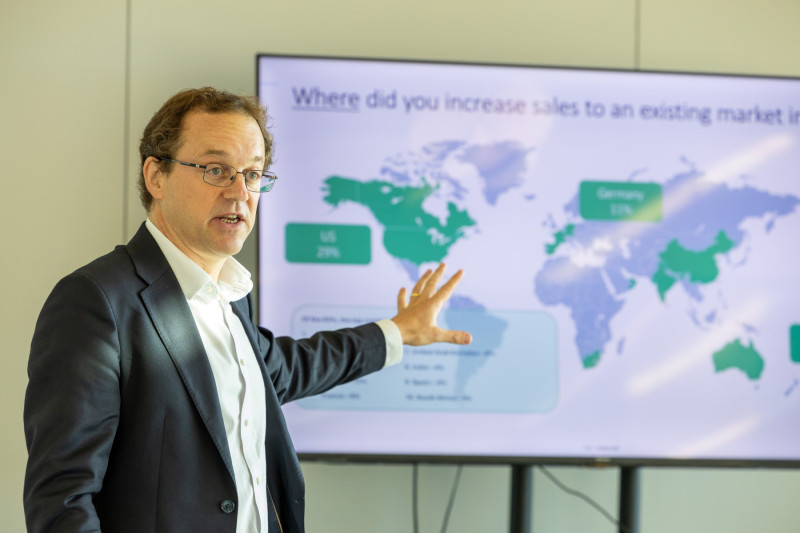 Andrew Macmillan, MAG Chief Strategy Officer, said: “We are right to be proud of the British businesses that export their goods and services around the world, and it is positive to see so many increased sales or entered new markets in the first quarter of the year.
“It is also encouraging that the data shows firms are active in a diverse range of markets, all of which the UK is directly connected to by ports and airports up and down the country.
“There is clear evidence that cities and regions with strong concentrations of exporting businesses are more productive and have higher living standards.
“Therefore, encouraging more companies across the UK to start trading in a diverse range of overseas markets will hold the key to the Government achieving its long-term growth mission.
“News of a trade deal with India, combined a new direct route to Manchester launching in July, is just one example of Government working together with business to connect key UK growth corridors to fast-growing global markets.”
The significant regional variations reinforce calls for Local Growth Plans and the Government’s new Industrial Strategy to focus on supporting more businesses in high-growth sectors like life sciences, technology and advanced manufacturing to go global.
 Henri Murison, Chief Executive of the Northern Powerhouse Partnership and Chair of the Growing Together Alliance, said:
“The first edition of the trade barometer shows the baseline of business sentiment at the end of Q1 this year. By looking back immediately before the current period of uncertainty, we can see the path by which both individual companies, and the country, can respond.
“Whether it be in the life sciences - which are strong in both the North and in the Ox-Cam corridor - or in areas like advanced manufacturing, the need for closer relationships with Europe can’t be underestimated. That is illustrated in particular by the importance of France and Germany – as well as the wider trading bloc - as key markets for all businesses surveyed.
“To capitalise on whatever trade deals the UK can negotiate, we also need a new Industrial Strategy that sees the Government’s work towards it significant growth ambitions with Metro Mayors and businesses in our regions.
“Whether it be key levers like innovation or transport connectivity, we know what has held us back in regions like the North in the past. Addressing these barriers will help tackle long-term productivity deficits and enable significant additional growth through exports.
“I am confident that - unlike “Levelling-Up”, which set our regions against one another, that we can see all parts of the country, including London, the Central South or West of England all thrive alongside the North.”
ENDS
------------------------------------
Notes to Editors
Manchester Airports Group (MAG) is the UK’s largest airports group. Its owns and operates Manchester, London Stansted and East Midlands Airports, alongside digital services business CAVU. Headquartered in Manchester, the Group is the UK’s largest private investor in transport infrastructure outside of the M25.
In 2024/25, MAG served more than 65m passengers, flying to more than 260 global destinations. As part of its commitment to creating a more sustainable future for all, MAG has a target to make it’s airport operations net zero carbon by 2038 and is working with industry partners towards net zero aviation in the UK by 2050.
Link to MAG work with WPI on the UK as a “services superpower” - https://wpieconomics.com/wp-content/uploads/2024/06/MAG-Report-Web-Version-240514.pdf
The Growing Together Alliance is a coalition of six major business organisations representing England’s leading city regions: BusinessLDN, Business South, Business West, Cambridge Ahead, Northern Powerhouse Partnership, and the North West Business Leadership Team. It focuses on driving place-based economic strategy to boost regional productivity and support good growth—particularly through strengthening innovation, spatial planning, and foreign direct investment.
-----------------------------